Contributions
- 1
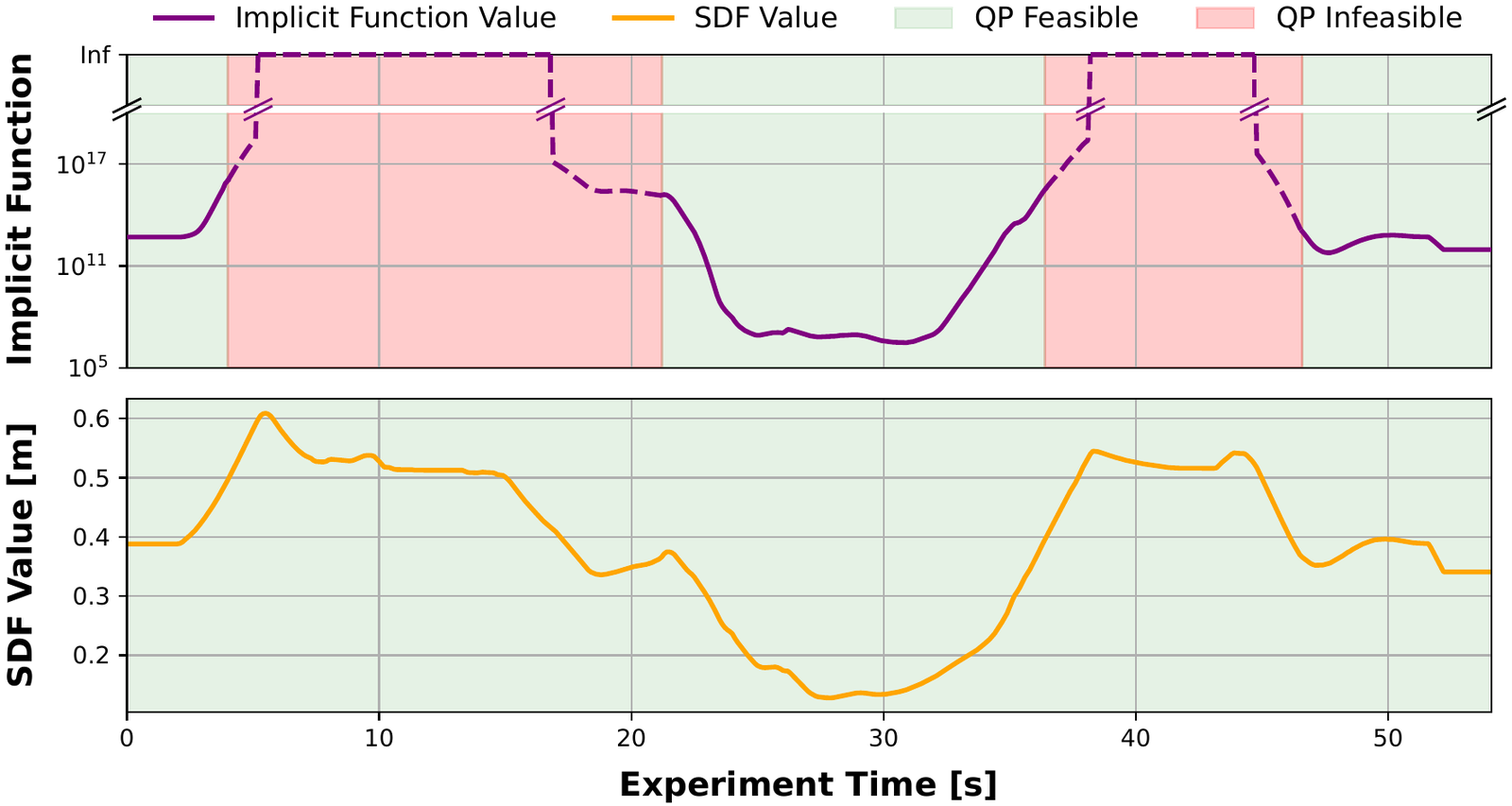
The implicit function is the wrong barrier for superquadrics. Prior work uses the implicit function of the superquadric directly as the barrier in a CBF-based safety filter. We identify that both the implicit function value and its gradient can be ill-conditioned, which can make the underlying optimization infeasible.
- 2
Signed distance as a remedy. Alternatively, we propose to use the signed distance between superquadrics as the barrier, which maintains a graient norm of 1 almost everywhere. We further verify the proposed formulation on a representative case and show that it remains well-conditioned despite sharp corners and large separations.
- 3
An efficient approach for signed distance and gradient computation. We evaluate the distance and its gradient between superquadrics in real time using dense polytopic approximations and the GJK/EPA algorithm, with a robustness analysis that accounts for the approximation error in the safety margin.
Abstract
Ensuring safe robot operation in cluttered and dynamic environments remains a fundamental challenge. While control barrier functions (CBFs) provide an effective framework for real-time safety filtering, their performance critically depends on the underlying geometric representation, which is often simplified, leading to either overly conservative behavior or insufficient collision coverage. Superquadrics (SQs) offer an expressive way to model complex shapes using a few primitives and are increasingly used for robot safety. To integrate this representation into CBF, most existing approaches directly use their implicit functions as barrier candidates. However, we identify a critical but overlooked issue in this practice: the gradients of the implicit SQ function can become severely ill-conditioned, potentially rendering the optimization infeasible and undermining reliable safety filtering. To address this issue, we formulate an SQ-based safety filter that uses signed distance functions (SDFs) as barrier candidates. Since analytical SDFs are unavailable for general SQs, we compute the distance using the efficient Gilbert–Johnson–Keerthi algorithm and derive its gradient in closed form. Extensive simulation and real-world experiments demonstrate consistent collision-free manipulation in cluttered scenes, showing robustness to challenging geometries, sensing noise, and dynamic disturbances, while improving task efficiency in teleoperation tasks. These results highlight a pathway toward safety filters that remain precise and reliable under the geometric complexity of real-world environments.
KeywordsRobot safety·Collision avoidance·Computational geometry·Control barrier functions·Superquadrics
Superquadrics are expressive, but their implicit function is a poor barrier candidate.
The superquadric allow us to represent a wide family of shapes, from spheres to rounded boxes, with a minimal set of parameters. Prior works often use its implicit function directly as a control barrier function, which is not a distance metirc and could be severely ill-conditioned: for box-like shapes and large separations, its value and its gradient grow by several orders of magnitude, and the CBF-QP becomes ill-conditioned or infeasible. In the same setup, the signed distance always remains bounded and well-conditioned.
Superquadrics: one primitive, various shapes
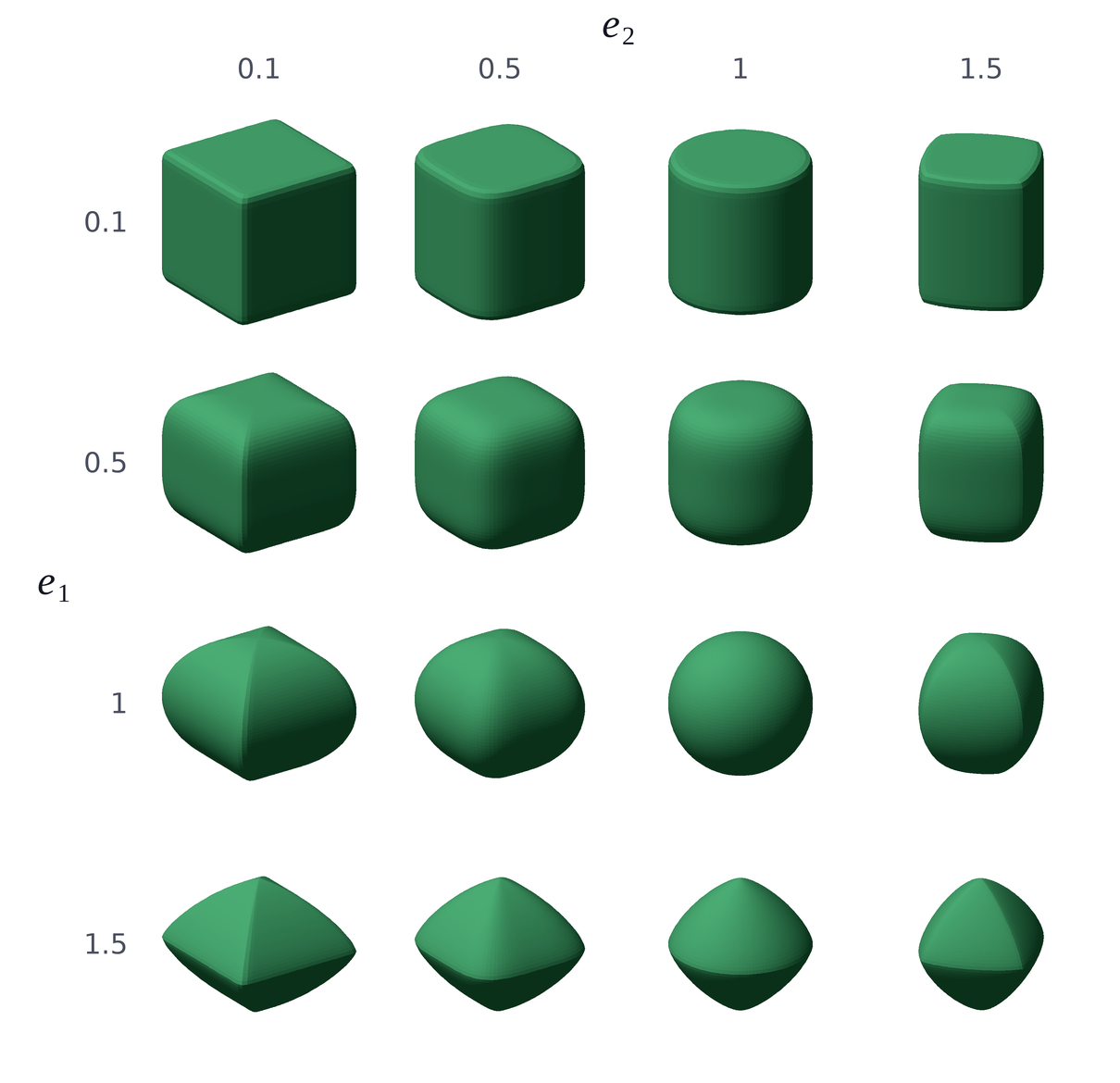
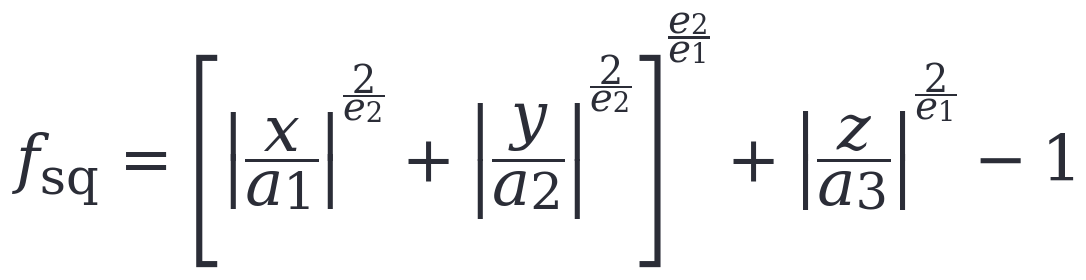
Strictly convex for 0 < e1, e2 < 2. Click a cell above or move the sliders.
Implicit function vs. signed distance
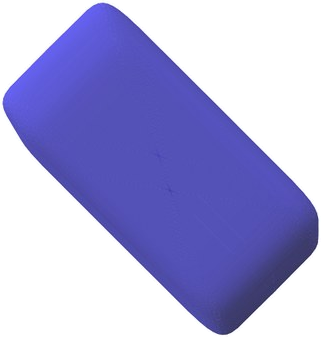
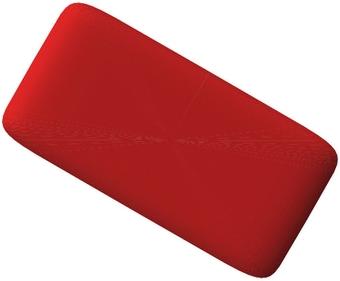 Drag the blue shape
The SQ-CBF safety filter
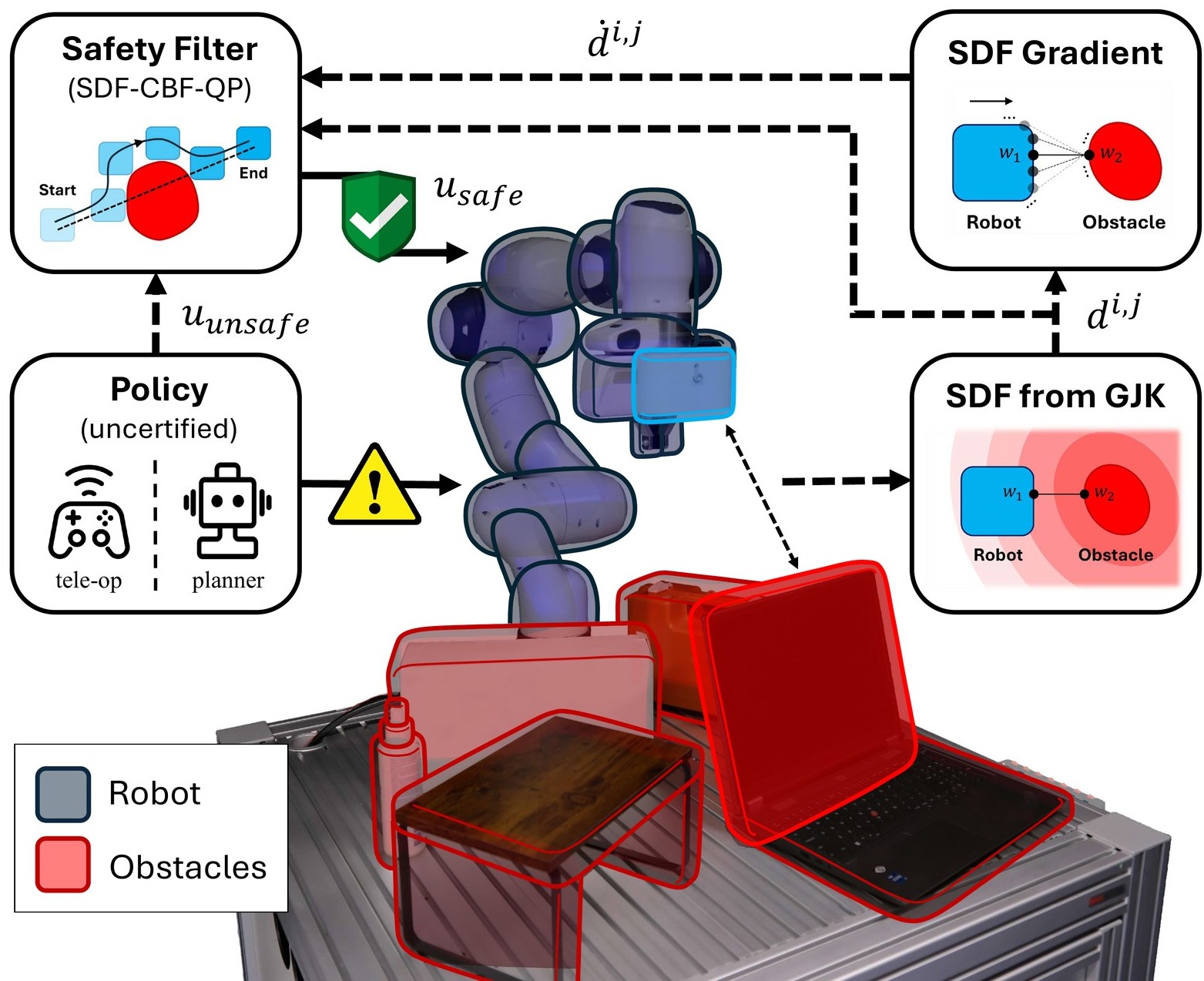
Robot and obstacles are both represented by compact sets of superquadrics. The signed distance between every robot–obstacle pair is chosen as the barrier function, densely discretized as polytopics and computed with GJK/EPA, and its gradient is derived in closed form in terms of the superquadric poses and witness points.
- 1
Superquadric collision model
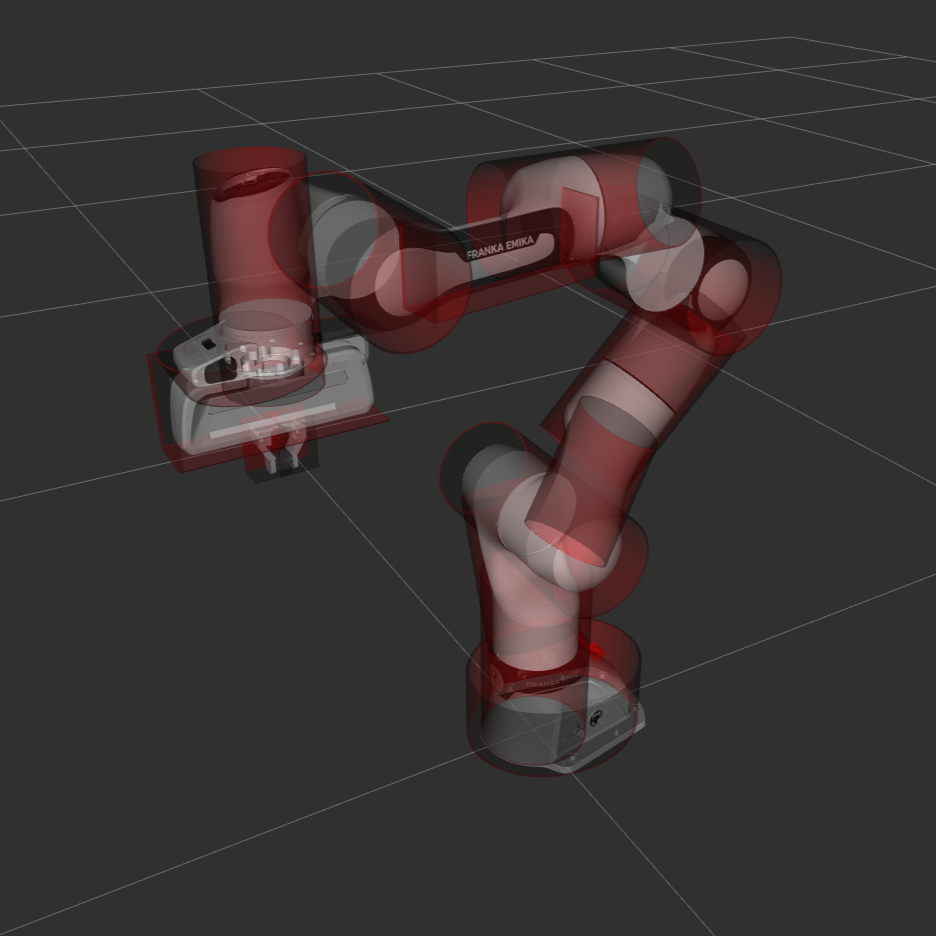
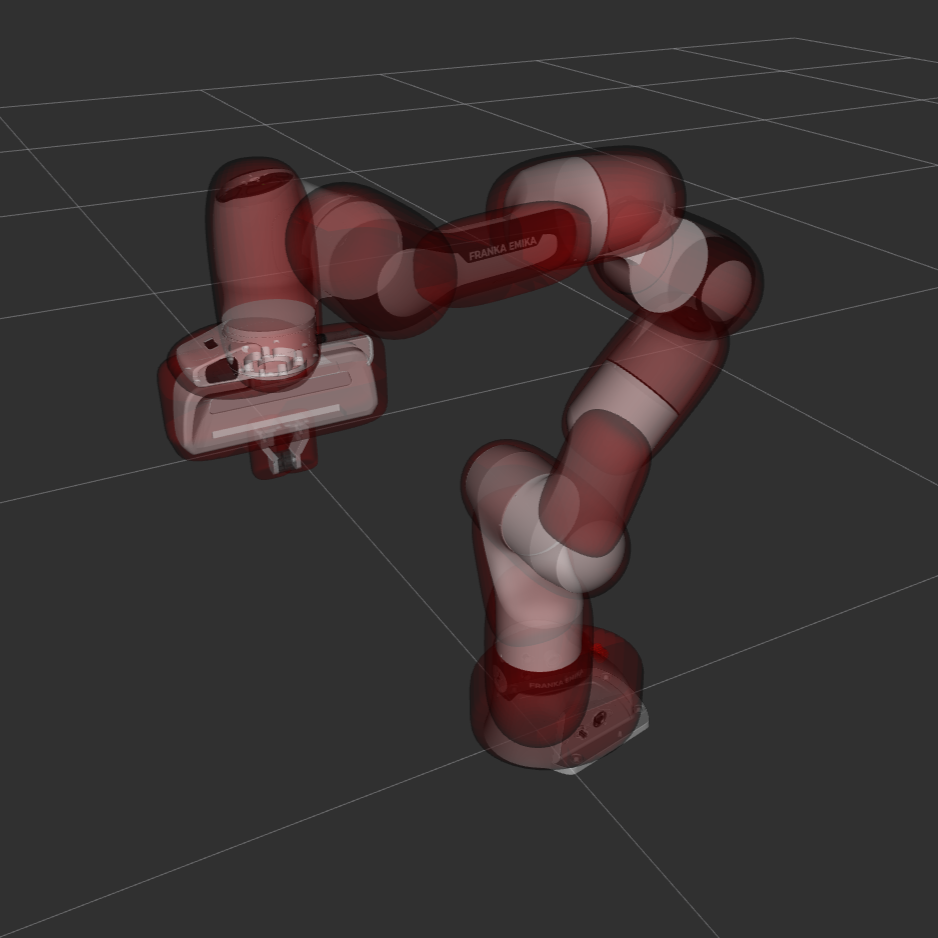
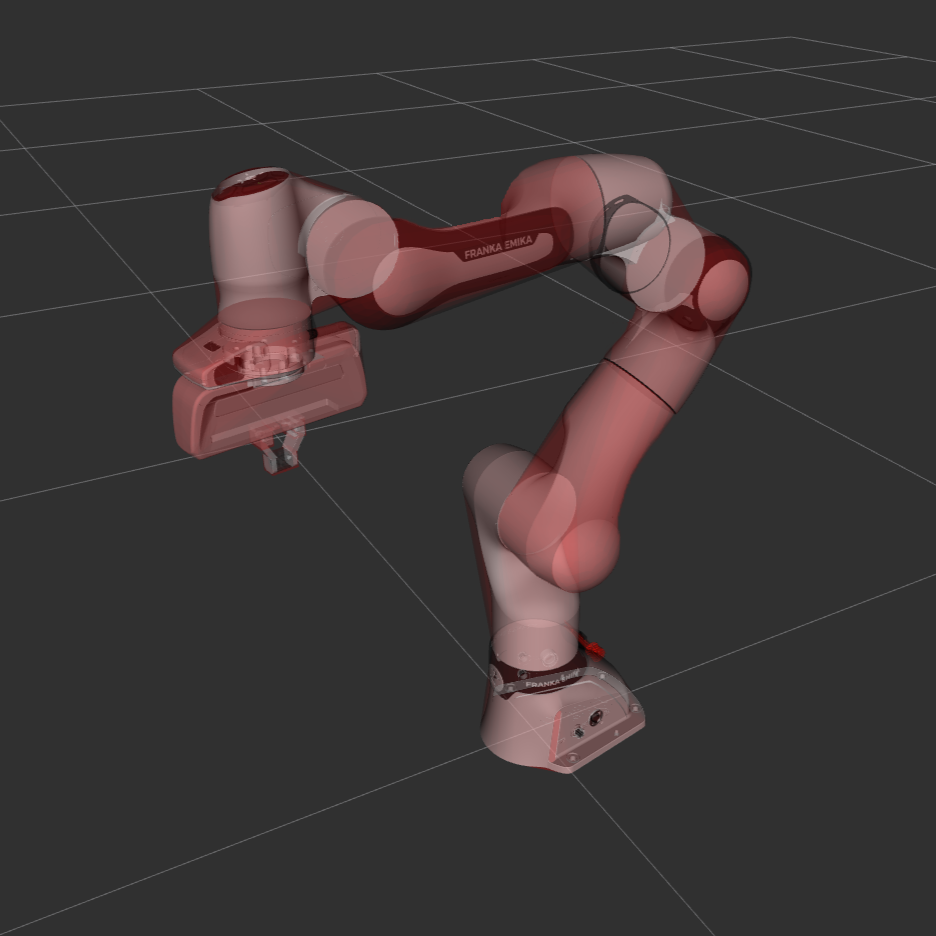
15 strictly convex superquadrics cover 97.1% of the Franka FR3 with substantially less over-approximation than cylinders and boxes.
- 2
Signed distance as barrier function
We choose h = d − εδ. Between strictly convex bodies the SDF is continuously differentiable wherever they are positively separated, so it's a valid CBF on the safe set. Each superquadric is densely sampled into a convex polytope, and GJK/EPA evaluates the distance in real time.
- 3
Closed-form gradient
Positive homogeneity of the support function eliminates all Hessian terms, such that the SDF Jacobian expression requires only the 6D pose of superquadrics and the witness points.
- 4
Robust margin
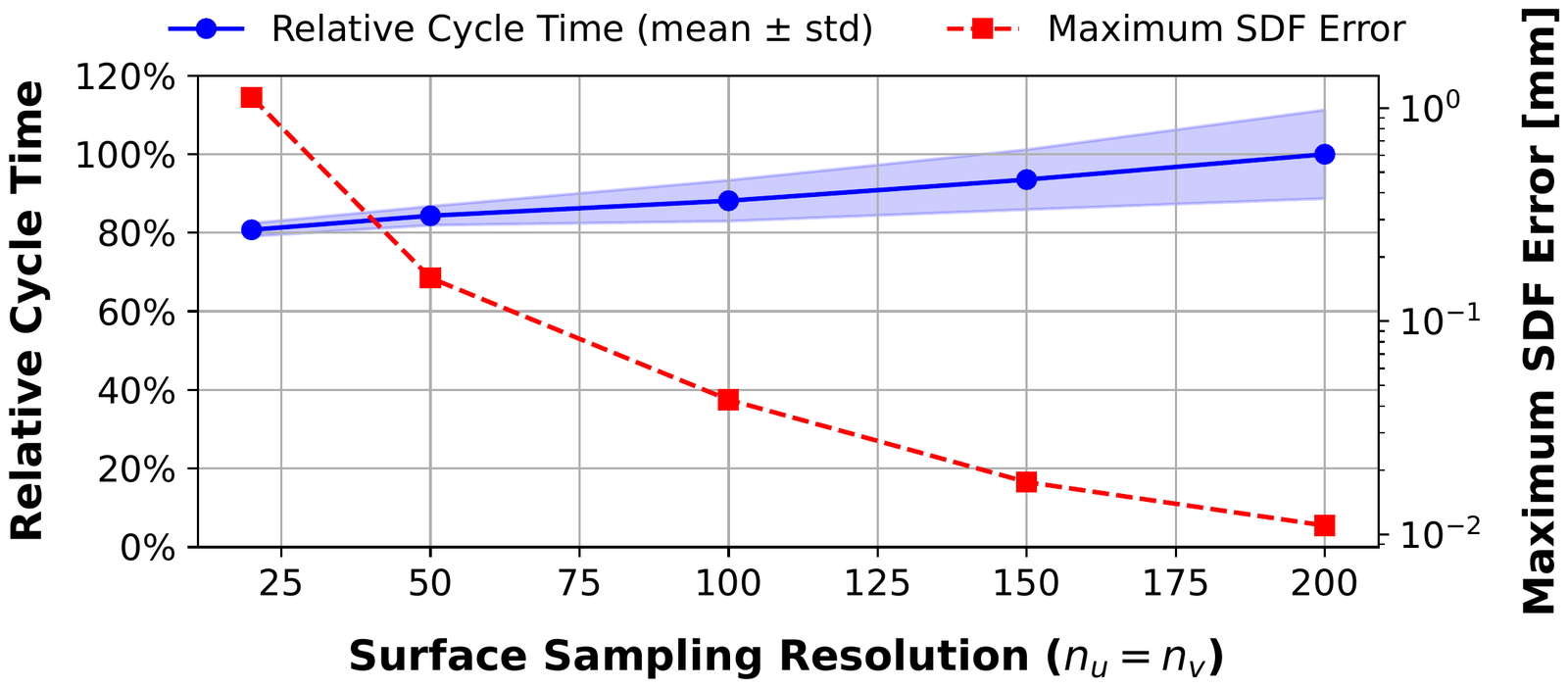
The polytope discretisation error is bounded and incorporated into the CBF margin. In this way we ensure that satisfying the approximate constraint implies the exact one. At 200×200 samples the additional margin is ~0.84 mm.
Complete, fast and accurate
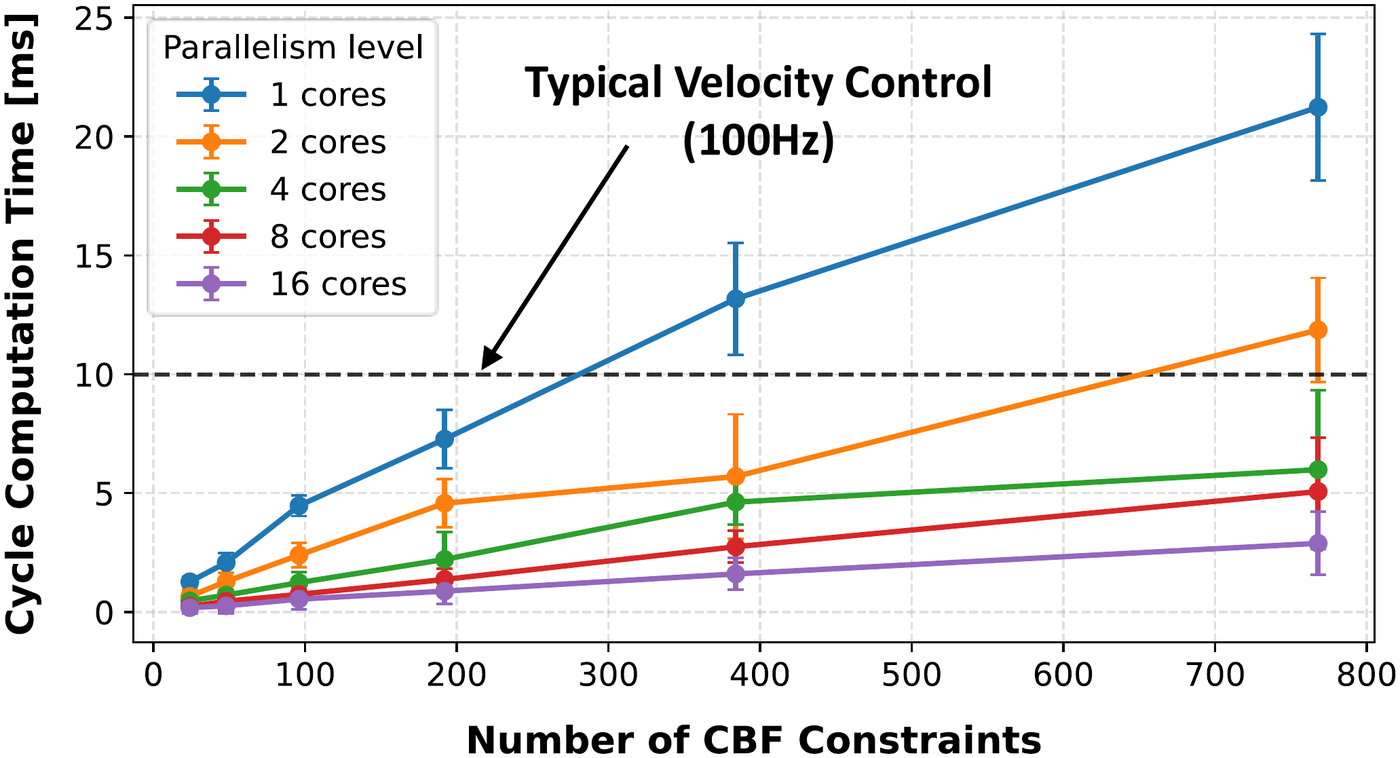
Three key properties of the proposed superquadric representation with SDF-based formulation, examined on the Franka FR3 and an Intel Core Ultra 9 285K.
Complete without being conservative
Coverage and over-approximation of the robot collision model, measured by voxelisation at 5 mm.
| Representation | SpheresMorton & Pavone, 2025 | Cylinders / boxesGonçalves et al., 2024 | Superquadrics (ours) | Official FR3 meshOfficial repo |
|---|---|---|---|---|
| Illustration | 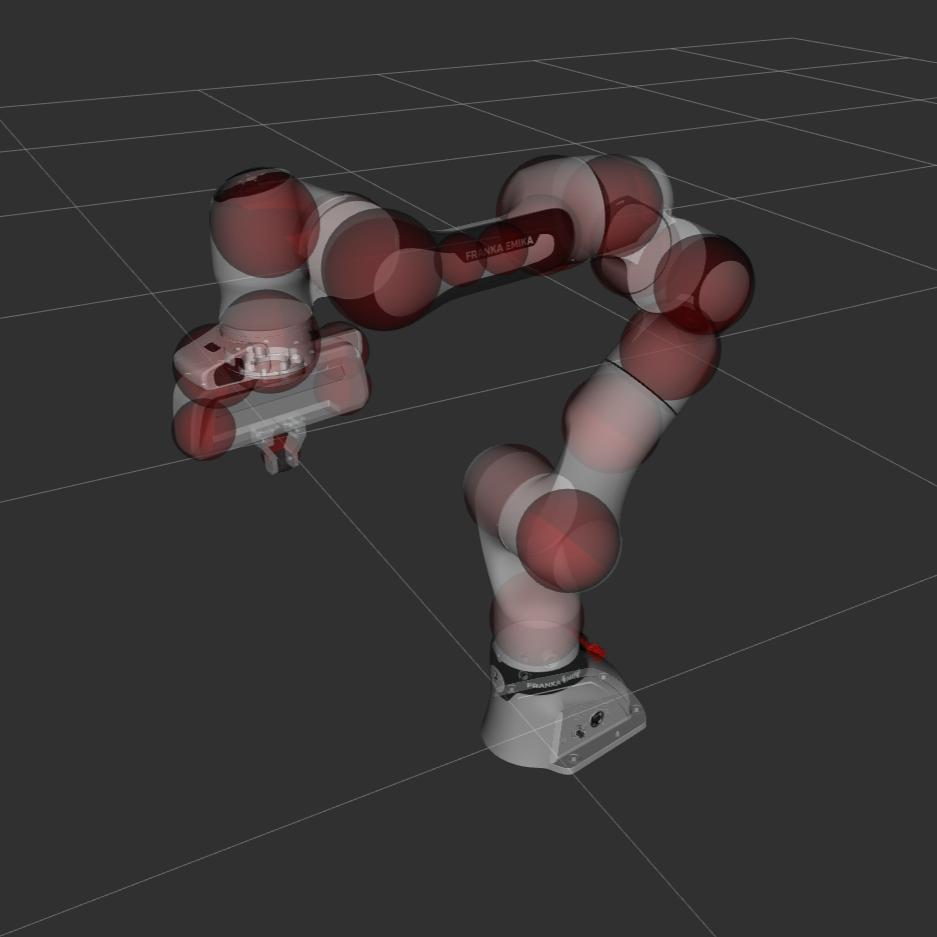 |
 |
 |
 |
| Primitives | 21 spheres | 11 cylinders + 4 boxes | 15 superquadrics | 9 meshes + 8 boxes |
| Coverage ↑ | 59.1% | 99.0% | 97.1% | 97.3% |
| Over-approx. ↓ | 2.6% | 45.2% | 28.7% | 1.9% |
| Convexity | strictly convex | not strictly convex | strictly convex | non-convex |
Real time, at scene scale
High accuracy at little computational cost
Real-world experiments
A non-expert operator teleoperates a Franka FR3 at 100 Hz, performing the same task with and without the safety filter. Videos are shown in real time.
Handover in a tight space
Whole-body collision avoidance between three wooden posts.
Transport through narrow passages
End-effector and grasped object collision avoidance in an unstructured tabletop scene.
Why the implicit function-based formulation turns infeasible frequently on this trajectory?
Moving obstacles
Obstacle poses from motion capture at 200 Hz, velocities from an EKF. The filter reacts to a swinging stick while the operator moves freely or plays chess.
Safety that makes teleoperation faster
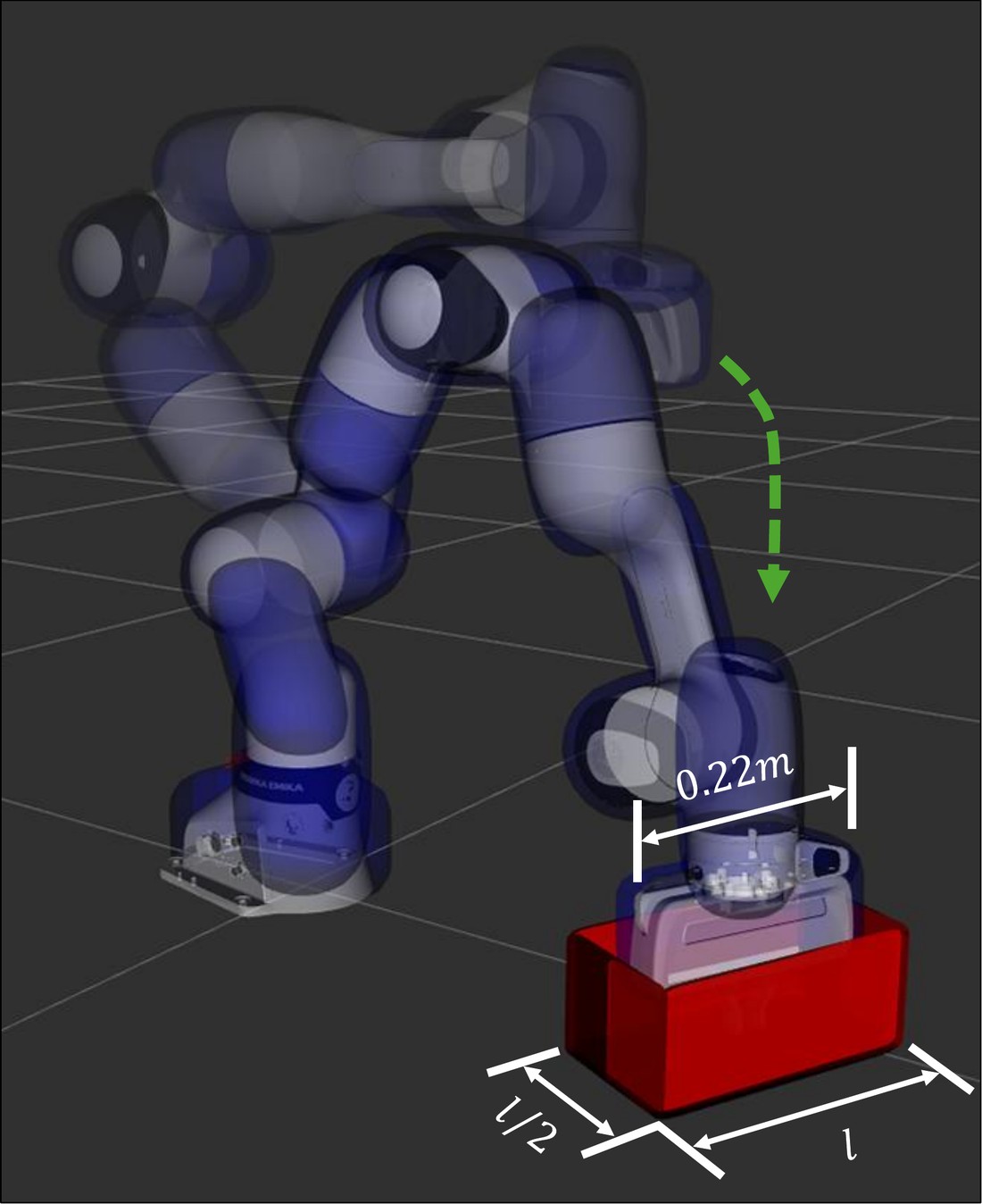
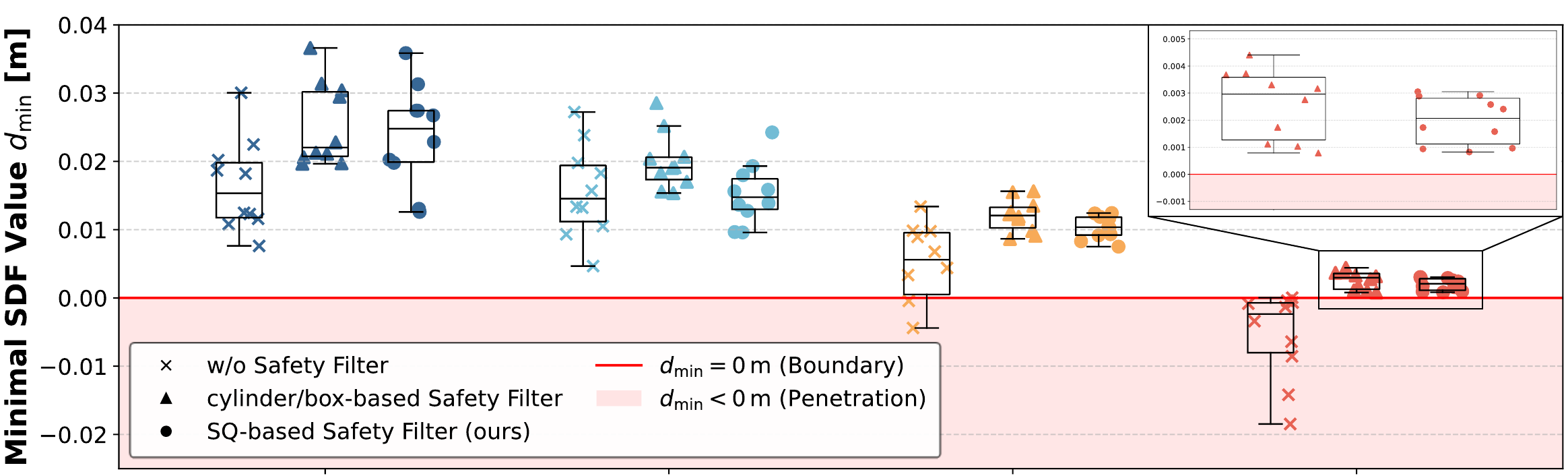
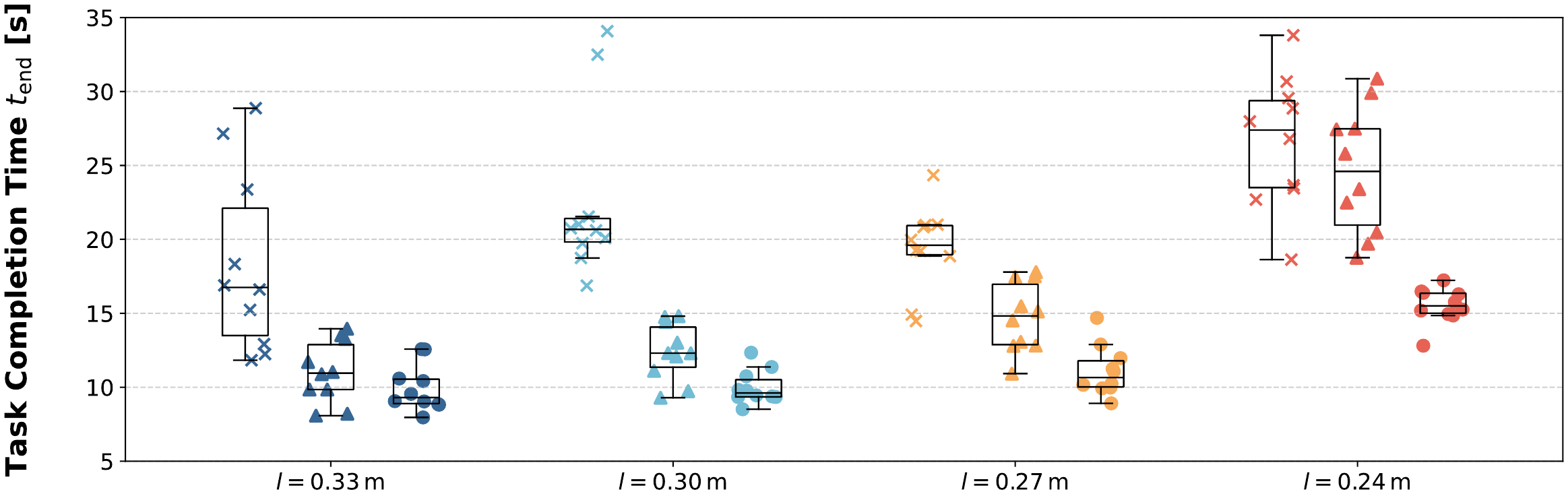
Ten teleoperated trials per configuration: the operator inserts the gripper into a basket whose clearance shrinks from 5.5 cm to 0.5 cm per side. With the filter, the operator no longer needs to stop and reposition the end-effector manually.
Citation
@article{zhao2026sqcbfsigneddistancefunctions,
      title={SQ-CBF: Signed Distance Functions for Reliable Superquadric-Based Safety Filtering},
      author={Haocheng Zhao and Lukas Brunke and Oliver Lagerquist and Siqi Zhou and Angela P. Schoellig},
      year={2026},
      journal={IEEE Robotics and Automation Letters (RA-L)}
}