Control for Robotics
From Optimal Control to Reinforcement Learning






Welcome to Control for Robotics! This three-course series will take you on a journey from the foundations of optimal control all the way to deep reinforcement learning, with robot decision-making as the central theme. We begin by introducing key theoretical concepts with interactive code examples for each core algorithm to establish a clear connection between mathematical principles and their practical implementations. A set of programming exercises and a real-world drone challenge then provide hands-on experience in applying these methods to both simulated and physical robotic systems. Through this progression, whether you are a student or a practitioner, you will develop the skills to design controllers for complex, real-world robots.
The manuscript for the courses comprises nine chapters. These will be released one by one over the course of the Summer 2026 term.
- Introduction to Optimal Control
- Linear Quadratic Optimal Control
- Optimization Fundamentals
- Iterative Optimal Control Algorithms
- Model Predictive Control
- Model Learning and Learning-Based Control
- Introduction to Reinforcement Learning
- Deep Reinforcement Learning
- Quadrotor Case Study
Below is a suite of three courses, each with hands-on components, ranging from the fundamentals of optimal control to state-of-the-art robot learning and real-world experiments.
Decision-Making
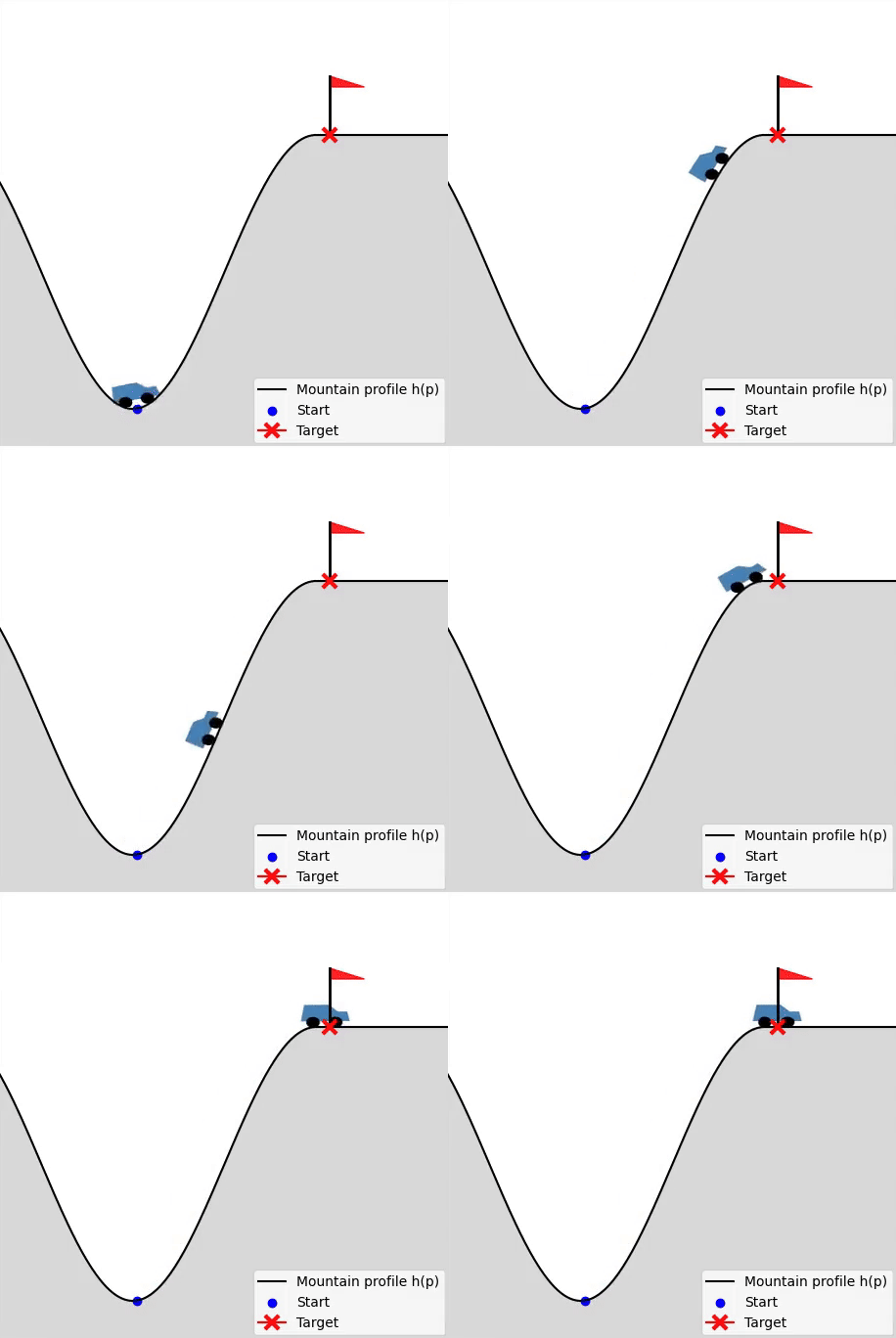
This course covers a set of topics in optimal control, optimization and learning-based control, with a focus on theoretical foundations and practical algorithm design. Through a combination of theoretical insights and algorithmic development, this course provides you with the knowledge and tools needed to design effective control strategies for dynamic systems, with attention to real-world challenges such as disturbances, model uncertainties, and constraint handling.
Decision-Making
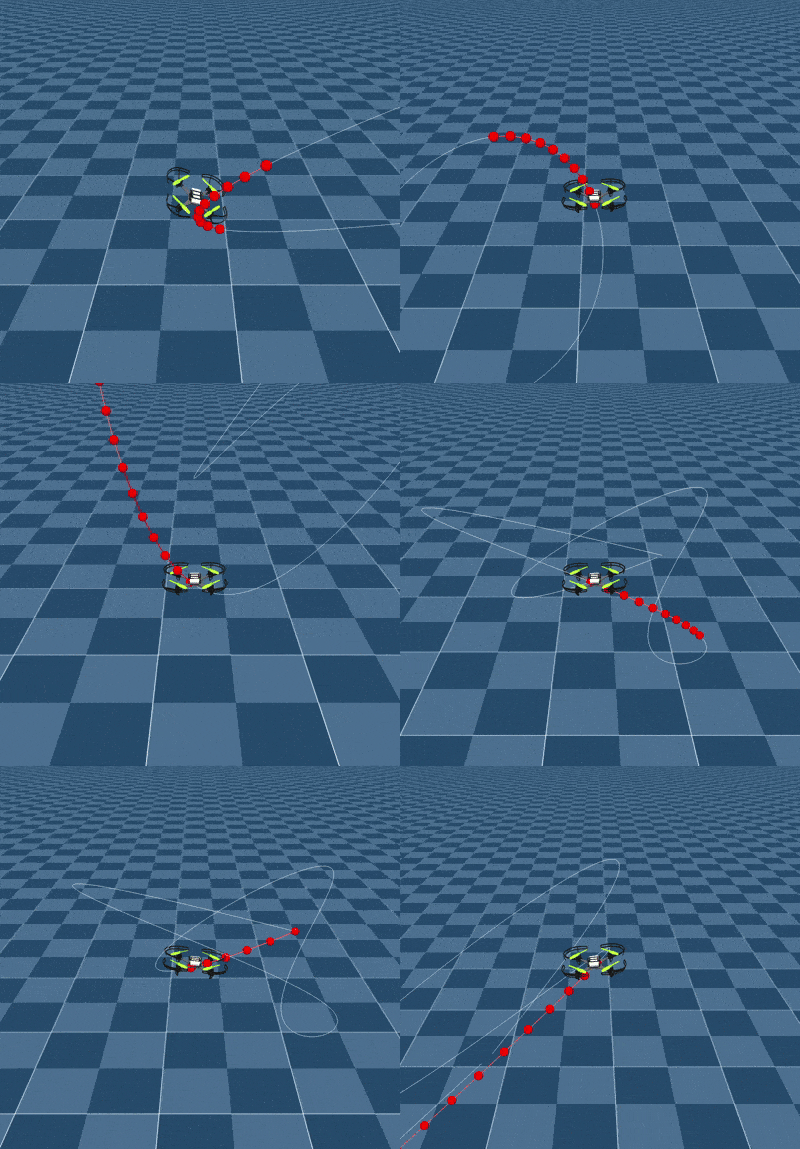
This course covers advanced topics in robot learning and control and includes a set of programming exercises to equip you with the skills to tackle real-world robotics challenges. The course emphasizes a systems-oriented approach, introducing modelling techniques for robot systems, optimal control methods, advanced learning-based control approaches, and deep reinforcement learning tailored to robotic applications.
Racing Project
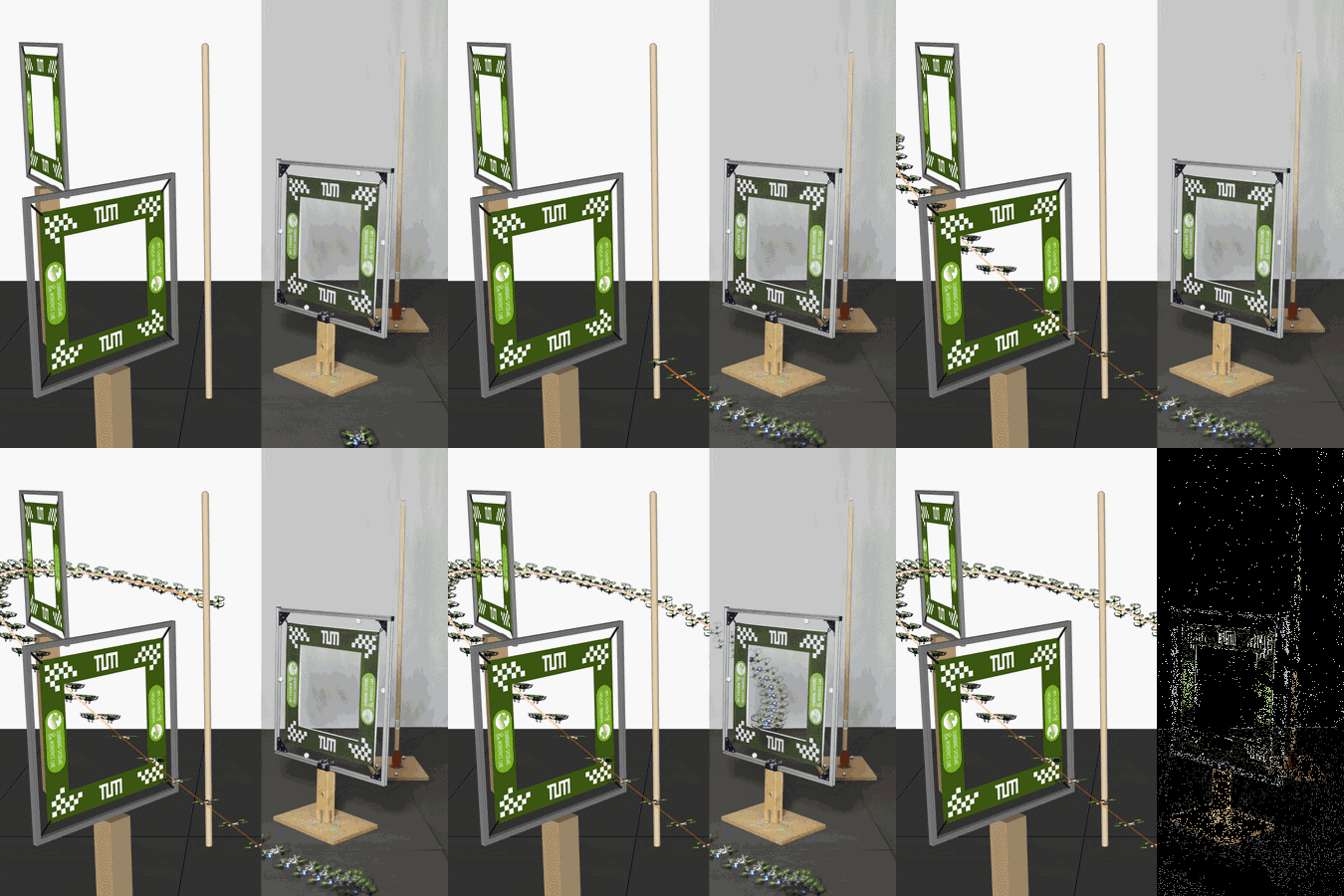
This is a hands-on project course where you will develop and iterate on algorithm designs to solve an autonomous drone racing challenge. The methods are first evaluated in simulation across four levels of difficulty, ranging from perfect knowledge to additional environment uncertainties that require online planning. Upon successful evaluation, you will later deploy the algorithms in real-time experiments.
Citation
If you use the manuscript in your work, please cite it using the BibTeX entry below:
@book{cfr-manuscript,
  title    = {{Control for Robotics:} From Optimal Control to Reinforcement Learning},
  authors  = {Angela P. Schoellig and SiQi Zhou},
  year     = {2025}
}
Authors
The courses have been a collaborative effort over multiple years involving many contributors. The main authors of the manuscript are:| Angela P. Schoellig | Technical University of Munich |
| SiQi Zhou | Simon Fraser University |
- Lukas Brunke
- Martin Schuck
- Ralf Römer
- Oliver Hausdörfer
- Adam Hall
- Haocheng Zhao
- Luca Worbis
- Barry Yeh
- Marcel Rath
- Niklas Schlüter
We would like to thank our teaching assistants, whose dedication and hard work have been essential to delivering these courses.